Baicalin 85% (Scutellaria Extract)
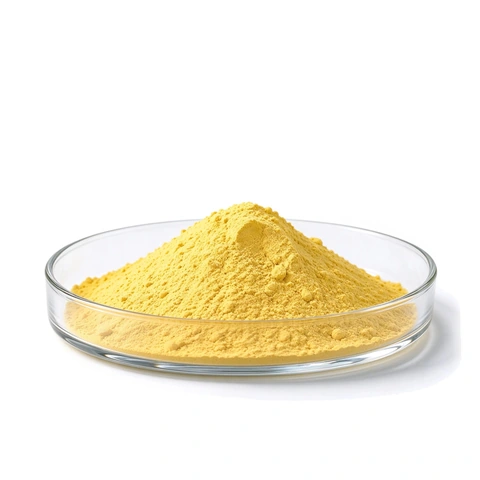
Baicalin (CAS 21967-41-9) is the marker flavone glycoside of Scutellaria baicalensis root. This extract grade is standardised to ≥85% baicalin on a dried basis (batch result 85.3%), with the original manufacturer's test report supplied with every order. Suited to botanical formulations, cosmetic and health-food blends, and as feedstock for baicalein production.
Tags:Product Specifications
- Product name
- Baicalin (Scutellaria extract)
- CAS
- 21967-41-9
- Molecular formula
- C₂₁H₁₈O₁₁
- Molecular weight
- 446.36
- Botanical source
- Huangqin (Scutellaria baicalensis)
- Plant part
- Dried root
- Grade
- Extract standardised to baicalin, not a reference-standard monomer
- MOQ
- 1 kg
- Packaging
- 1 kg foil bag / 25 kg fiber drum
- Lead time
- In stock, ships in 3 business days
- Customization
- Custom assay and packaging available
- Sample
- 10–20 g available for evaluation
- Assay
- ≥85% baicalin, on dried basis (batch: 85.3%)
- Test basis
- Manufacturer's enterprise standard; HPLC verification available
- Appearance
- Brownish-yellow powder (spec: brownish-yellow to pale yellow)
- Identification
- Positive reaction
- Loss on drying
- 2.7% (limit ≤8%)
- Solubility
- Slightly soluble in water; soluble in methanol/ethanol; readily soluble in alkaline solution as the salt
- Heavy metals / microbes
- Not listed on this batch report; third-party testing can be arranged on request
- Particle size
- Not stated on this batch report; confirm against the current batch before ordering
Batch test items (enterprise standard)
Additional testing
Product Details
Baicalin (CAS 21967-41-9) is the 7-O-glucuronide of baicalein and the marker compound by which the Chinese Pharmacopoeia evaluates Scutellaria root. This product is a Scutellaria root extract standardised to baicalin ≥85% on a dried basis — not a ≥98% reference-standard monomer. The batch report is headed "Scutellaria baicalensis extract" (the manufacturer's sample name), while its assay line states baicalin >85% on a dried basis, measured at 85.3%.
Production path: boiling-water extraction of the dried root (which also deactivates endogenous enzymes) → acid adjustment and precipitation → decolorisation and purification → drying and milling. Extraction without enzyme deactivation allows baicalin to hydrolyse into baicalein in the tank, which is why the assay basis and process control matter more than the grade number alone.
Common uses: raw material for botanical-extract blends, cosmetic and health-food formulations, feedstock for baicalein production by hydrolysis, and qualitative or preparative research. Scope of use and limits depend on the regulations of the destination market — confirm local permitted lists and labelling before exporting to the EU or the US.
- Not the same as baicalein: baicalin is the glycoside (CAS 21967-41-9); baicalein is the aglycone (CAS 491-67-8). Their assays are not interchangeable.
- Grade guidance: 85% is a cost-effective extract grade for formulation work. For quantitative analysis or pharmacopoeial reference work, choose a certified ≥98% baicalin standard.
- Colour: brownish-yellow powder, as recorded on this batch report. Colour alone is not an assay indicator; check the certificate of analysis.
Botanical Source
Manufacturing
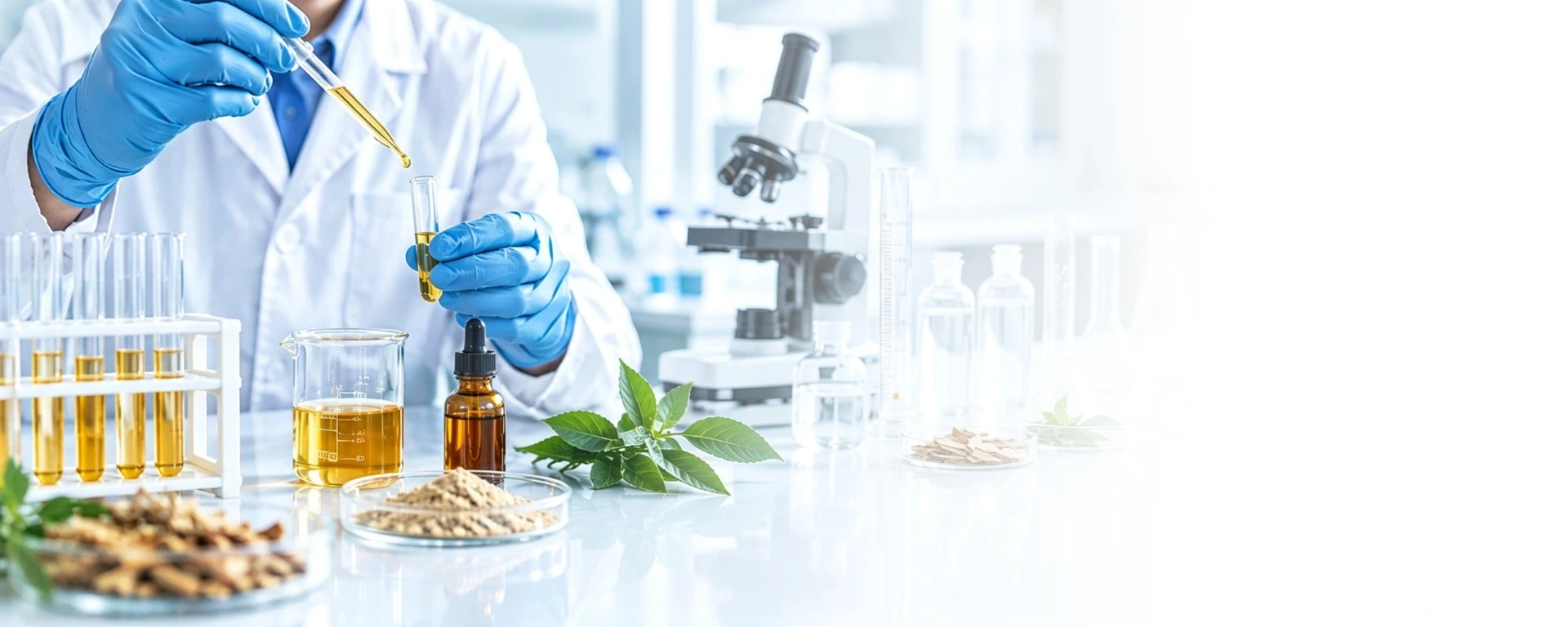
Extraction, acid precipitation and refining are completed in the same facility: the root is extracted with boiling water, the liquor is acidified to precipitate crude baicalin, then decolorised, purified, dried and milled. Enzyme deactivation during extraction is the critical control point — without it the glycoside hydrolyses and the finished assay no longer matches the specification. Zoned GMP operations keep batch records traceable to equipment, shifts and operators.
- Cleanliness grade
- Grade D clean area for refining and inner packaging
- Annual capacity
- Extracts 600 t / year
- Certifications
- GMP, ISO 9001, HALAL
Quality & Compliance
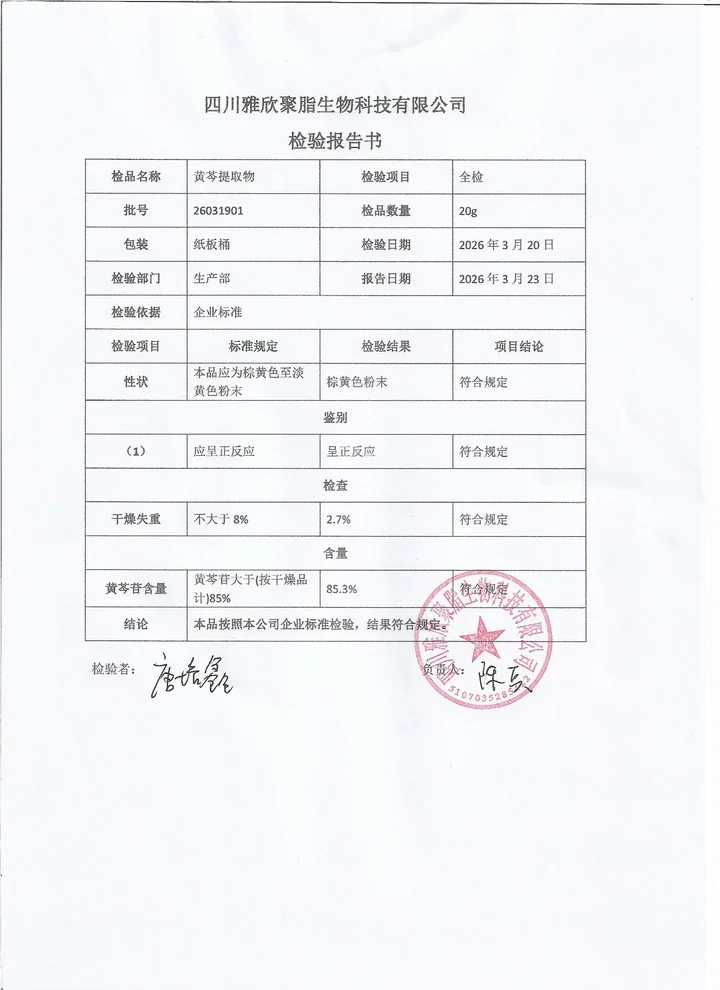
Each batch is released against the manufacturer's enterprise standard. The report reproduced below covers appearance, identification, loss on drying and baicalin assay on a dried basis; the batch shown measured 85.3% against a >85% limit, with loss on drying 2.7% against an ≤8% limit.
Read the report as issued: the manufacturer entered "Scutellaria baicalensis extract" as the sample name, which is a naming convention for the extract grade, not a different substance. The assay line identifies baicalin explicitly. Heavy metals, microbial limits and particle size are not covered by this report and can be tested separately on request. Our production system is certified to GMP and ISO 9001; export orders can be accompanied by MSDS, non-GMO statement and certificate of origin.
Certificate of Analysis
Batch 26031901, tested 20 March 2026, report dated 23 March 2026, issued by Sichuan Yaxin Juzhi Biotechnology Co., Ltd. The sample name on the original report reads "Scutellaria baicalensis extract"; the assay item states baicalin >85% (on dried basis), measured 85.3%. The document is reproduced unaltered.
Packaging & Shipping
25 kg fiber drum is the standard export package, with a double-layer PE bag liner and a batch label on the drum; 1 kg and below use foil bag plus carton, suitable for sampling and small-batch trial production. The batch report lists paperboard drum packaging.
- MOQ: 1 kg; full drum 25 kg, better unit price for full-drum orders.
- Lead time: In stock, shipped within 3 business days, excluding holidays.
- Logistics: Domestic express and freight can be arranged; for export we provide MSDS and COA, and can issue non-GMO and certificate-of-origin statements on request.
Storage requirements: Store in a cool, dry place, sealed and protected from light, away from strong oxidizers; shelf life 24 months unopened. Baicalin absorbs moisture readily — reseal promptly after opening.
FAQ
Why does the report say "Scutellaria baicalensis extract"?
That is the manufacturer's sample name for the extract grade. The report's assay item explicitly measures baicalin on a dried basis (>85%, result 85.3%), and the product is supplied and quoted as baicalin 85% (Scutellaria extract), CAS 21967-41-9. We reproduce the original document without alteration.
Is this a ≥98% baicalin reference standard?
No. It is an extract standardised to ≥85% baicalin. For quantitative analysis or pharmacopoeial work, use a certified reference standard; the 85% grade suits formulation, hydrolysis feedstock and qualitative identification.
How is baicalin different from baicalein?
Baicalin (CAS 21967-41-9) is the glycoside; baicalein (CAS 491-67-8) is the aglycone after removal of the glucuronic acid group. Their molecular weights, solubility and assay values are different and cannot be converted by a simple percentage.
Can you send a small sample first?
Yes, a 10–20 g evaluation sample is available for testing, freight collect; after confirming the quantity, the MOQ is 1 kg.
Technical Resources
- Baicalin Baicalin (CAS 21967-41-9) — the pharmacopoeial marker glycoside of Scutellaria root. Covers water extraction and acid precipitation, dried-basis assay, HPLC test points and 85%–98% grade selection.
- Scutellaria baicalensis
- Scutellaria grades and testing